
FG, Others Name 5 Institutions After Tinubu
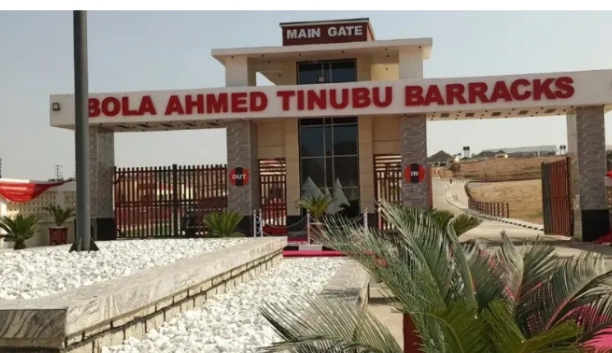
A wave of criticism has trailed the recent naming of a newly constructed army barracks in Asokoro, Abuja, after President Bola Ahmed Tinubu, bringing the number of institutions named after him to five since he assumed office in May 2023.
The Bola Ahmed Tinubu Barracks, inaugurated on January 23, 2025, comes shortly after the federal government approved the establishment of Bola Ahmed Tinubu Polytechnic, Gwarinpa, also in Abuja, to promote technological, vocational and entrepreneurial education.
The trend, according to findings, began 11 months ago when the Niger State Government in March 2024 renamed the Abubakar Imam International Airport in Minna as Bola Ahmed Tinubu International Airport, sparking outrage, particularly among residents of Rafi Local Government Area, the home of the late Abubakar Imam Kagara. The renaming was controversial as the airport had only been named after Abubakar Imam in June 2023 in recognition of his contributions to northern Nigeria’s literary, political and educational landscape.
Similarly, in May 2024, the National Assembly Library and Resource Centre was inaugurated and named the Bola Tinubu Building, while in December 2024, the Nigeria Immigration Service named its state-of-the-art technology complex after President Tinubu, citing his commitment to innovation.
Beyond these five institutions, there is also a proposed Bola Ahmed Tinubu Federal University of Nigerian Languages in Aba, Abia State. A bill for its establishment was introduced in the House of Representatives in October 2024, aimed at advancing higher education in Nigerian languages and cultures.
Weekend Trust reports that despite not breaching any known law, the trend of naming institutions after a sitting president has raised moral and ethical concerns. The controversy around these renaming exercises continues to intensify, particularly due to the perception that they are politically motivated.
Historical context of military barracks naming
Historically, the naming of military barracks has followed a pattern of honouring those who contributed significantly to the country, particularly in the context of wartime heroes or military leaders, or to recognise some significant historical locations, mostly relating to military events.
In an article titled Barracks: The History Behind Those Names, historian, Nowa Omoigui recalled how, in September 2002, the then Minister of Defence, Lt. Gen. TY Danjuma (retd) set up a Military Installation Naming Committee to assess the propriety of naming military installations after individuals. The committee comprised Brig-Gen Mobolaji Johnson (retd); Lt-Gen M. I. Wushishi (retd), General D. Y. Bali (retd), Major-General M. C. Ali (ertd) and Brig-Gen Pius Obi (retd), with Brig-Gen A. N. Bamali as the secretary,
Omoigui recalled that among other things, the committee was tasked: “To determine the propriety or otherwise of naming military installations after individuals; to examine ways of reviving the names inherited from colonial era that have now been abandoned; to recommend appropriate additional names arising from the Nigerian Civil War, ECOMOG operations in Liberia and Sierra Leone and any other peacekeeping operation in which Nigerian troops suffered casualties.”
At the time, barracks were traditionally named after specific battles or locations in which Nigerian troops had been involved, particularly during the Nigerian Civil War and the peacekeeping operations in Liberia and Sierra Leone. For example, Arakan Barracks and Myohaung Barracks were named after campaigns during the World War II era, and Tamandu Barracks was named after a notable battle in the northern region.
Specifically, the minister was quoted as saying: “At no time was any barracks named after individuals, whether dead or alive. The first departure from this practice was recorded when the military cantonment in Kaduna was named after Alhaji Muhammadu Ribadu, the first Minister of Defence.”
The naming conventions for military barracks was updated after the review committee’s work, which led to several barracks being renamed after prominent Nigerian military figures, including Yakubu Gowon, Sani Abacha, Aguiyi Ironsi, Ibrahim Babangida, and Olusegun Obasanjo. The change was seen as an effort to honour and solidify the legacy of the country’s military leadership and to further instill a sense of patriotism.
But during the administration of President Umar Musa Yar’adua, the policy was partly reversed. It was ordered that military barracks, formations and institutions previously named after individuals — particularly former heads of state and military officers —should revert to their original names or be renamed in line with military traditions.
Accordingly, the Obasanjo Barracks in Abuja was renamed Mambilla Barracks; Mohammed Buhari Barracks reverted to its former name, Lungi Barracks; and Ibrahim Babangida Barracks changed back to Maimalari Barracks in Maiduguri.
The decision was seen as an effort to depersonalise national military assets and restore professionalism in the armed forces.
A moral Issue, not legal
While it is not uncommon for governments around the world to name institutions after past leaders or significant figures, critics have raised concerns about the practice of naming critical institutions after sitting presidents. In particular, the growing trend of naming various public facilities after President Tinubu has been met with widespread disapproval. Many argue that this practice reflects a troubling pattern of self-promotion and is not in line with democratic principles.