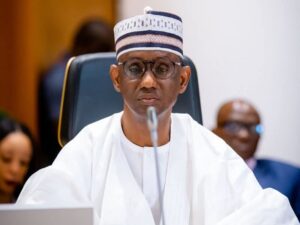

EXCLUSIVE: Government Should Support Private Investors, Not Build Film Studios — Shaibu Husseini

By Emanuella Drealomalicha
The Executive Director and Chief Executive Officer of the National Film and Video Censors Board (NFVCB), Dr Shaibu Husseini, has urged the government to prioritise incentives, financing and reliable infrastructure for private investors in Nigeria’s creative industry rather than directly establish and operate film studios.
Husseini made the call in an interview with ELLAAP NEWS while discussing the potential impact of actor and filmmaker Femi Adebayo’s newly unveiled Euphoria 360 Hub, a film and media production facility in Oregun, Lagos.
He described the development as a significant step towards strengthening Nigeria’s film industry, stressing that the country needs more privately owned production facilities capable of accommodating different types of projects, reducing production costs and creating employment opportunities for professionals across the creative sector.
According to him, the government’s primary responsibility should be to create an enabling environment that encourages private investors to establish and sustain such facilities.
“I don’t think that, with the way we are going, government should begin to set up those studios. But government can give incentives. Government can give finance to people to support their efforts in doing that,” he said.
Husseini explained that federal and state governments could encourage investment by providing land, extending financial support and offering appropriate concessions to entrepreneurs willing to establish production facilities and generate employment.
Using Adebayo’s Euphoria 360 Hub as an example, he suggested that incentives, including temporary licensing waivers for its cinemas where appropriate, could help ease the financial burden on investors during the early stages of operation.
He added that similar support could be extended to entrepreneurs seeking to establish community cinemas and other businesses within the creative economy.
Why Femi Adebayo’s Euphoria 360 Hub matters
Addressing concerns about the sustainability of major investments in film infrastructure, Husseini said the long-term viability of such projects depended partly on their ability to generate revenue from multiple sources.
He noted that Euphoria 360 Hub was not designed exclusively for filmmaking. The facility also includes cinemas, a podcast studio and spaces that can be hired for corporate events and other activities.
According to him, these additional services could provide alternative income streams to support the running and maintenance of the complex.
“If you were there on the day of the launch, you would find out that beyond establishing a studio to make films, he also has cinemas where he can earn revenue. He also has a podcast studio, knowing that these days a lot of people do podcasts,” Husseini said.
He expressed confidence that the facility could become financially sustainable if its different components were effectively managed and the available commercial opportunities fully explored.
However, he stressed the importance of conducting proper feasibility studies and developing viable business models before committing substantial resources to projects of this scale.
His comments come amid ongoing concerns about the high cost of filmmaking in Nigeria, including expenditure on equipment, locations, accommodation, transportation, production and post-production services.
For many filmmakers, access to suitable facilities can determine how efficiently a project is delivered and how much of the budget remains available for cast, crew and other essential production needs.
Nollywood needs flexible production facilities
Husseini also called for more purpose-built film facilities capable of accommodating different genres and production requirements rather than studios designed primarily for a particular type of movie.
He cited filmmaker Kunle Afolayan’s KAP Film Village and Resort in Igbojaye, Oyo State, as another example of private investment in film infrastructure.
The facility, developed by Afolayan, combines film production locations with accommodation and hospitality services. It gained prominence as a filming destination for productions including Anikulapo, demonstrating how a dedicated production environment can serve both filmmaking and tourism.
Husseini said facilities that give filmmakers access to essential resources can help reduce the logistical expenses associated with sourcing locations, equipment and accommodation separately.
He explained that production companies that own or control such resources could make them available to other filmmakers under agreed fees and conditions, creating opportunities for collaboration across the industry.
This arrangement, he said, could help production teams manage their budgets more effectively and redirect funds towards other priorities, including cast payments, artists’ welfare and related production expenses.
He further emphasised the importance of facilities that can be adapted to different creative purposes.
Speaking about Euphoria 360 Hub, Husseini said its design appeared to offer opportunities for filmmakers to recreate road scenes, vehicle chases and other sequences in a controlled environment, reducing their dependence on outdoor locations.
He also disclosed that the facility had already been used for a music video, which he described as an indication of the range of productions such spaces could accommodate.
Beyond filming, Husseini argued that stronger domestic production infrastructure could reduce the need for Nigerian filmmakers to travel abroad to access certain services, including post-production.
He maintained that developing more facilities locally would help reduce costs, improve efficiency and retain a greater share of creative industry spending within Nigeria.
Government urged to support production infrastructure
Beyond encouraging private investment, Husseini said the government should direct more support towards developing infrastructure across the creative economy.
He argued that financial assistance, incentives and other targeted interventions could enable private investors to establish facilities capable of serving filmmakers and other creative professionals over the long term.
He also challenged film distributors and marketers to consider investing in production infrastructure, noting that such investments could benefit the wider industry by reducing operating costs and improving access to essential resources.
For Husseini, the objective should be to build an ecosystem in which private investment, government support and industry collaboration work together to strengthen Nigeria’s film industry.
He maintained that government support should not necessarily mean direct ownership and operation of studios. Rather, public interventions could help reduce the risks associated with establishing capital-intensive facilities while allowing private investors to bring their expertise and commercial experience to the sector.
Creative Economy Development Fund in the works
Husseini also disclosed plans for a proposed Creative Economy Development Fund (CEDF), which he said would focus substantially on developing infrastructure for the creative industry.
He explained that the process was taking time because of efforts to establish a governance framework capable of ensuring the fund’s sustainability beyond the tenure of the administration introducing it.
According to him, the intention is to prevent the initiative from disappearing when a government leaves office.
He cited the ₦3 billion grant introduced under former President Goodluck Jonathan as an example of an intervention whose impact, in his view, could have been sustained more effectively through a long-term institutional structure.
“The former President Jonathan grant that he gave was a three-billion grant he gave was very good. But one aspect of it is that it wasn’t continued with because we didn’t put that structure that would make it continue whether he was in government or not,” he said.
Husseini said the proposed CEDF was being designed with a structure intended to ensure continuity beyond the current administration.
He stressed that sustainable funding arrangements were essential to the long-term development of the creative sector, particularly given the substantial investment required to establish and maintain production facilities.
“I am a supporter of sustainable funding, sustainable structures, structures that will last my generation and generations to come,” he said.
For the NFVCB chief executive, the future of Nigeria’s film industry depends not only on the talent of its filmmakers but also on the availability of infrastructure, access to finance and policies that encourage long-term investment.
He maintained that a combination of sustainable funding, private-sector participation and government-backed incentives could help build a stronger production ecosystem, create jobs and improve the competitiveness of Nigerian films.